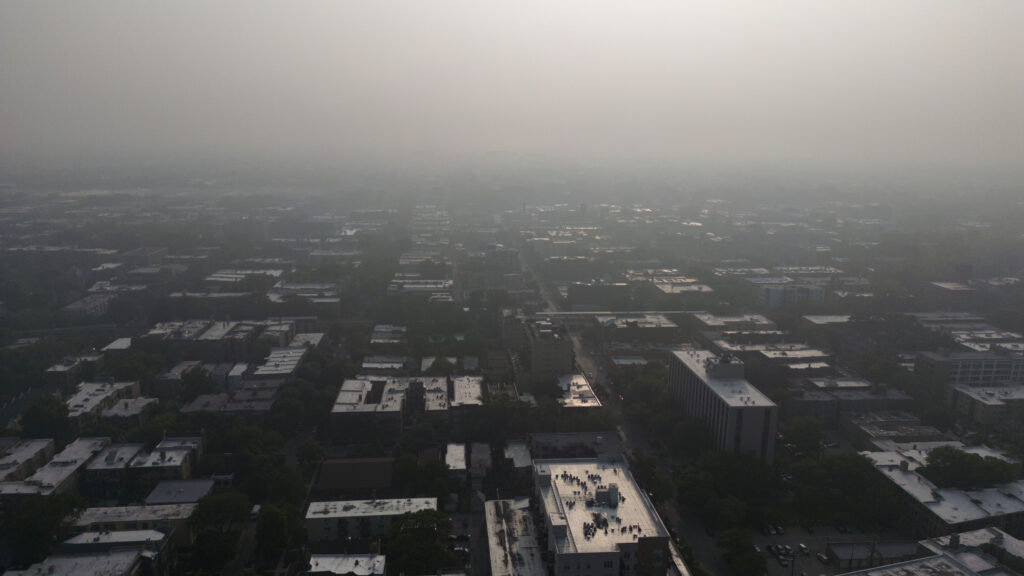
What is the value of a human life? According to the Trump administration’s Environmental Protection Agency, the answer is zero dollars.
Recently, in a decision buried in regulatory documents, the EPA announced it would no longer calculate the economic benefits of lives saved when setting limits on fine particulate matter and ozone, arguably two of the deadliest air pollutants, responsible for an estimated 135,000 premature American deaths every year. From now on, the agency will only tally the costs to industry. The benefits to human beings? Too uncertain to count, according to the EPA.
The science is far from uncertain. The landmark Harvard Six Cities Study, which tracked the health of thousands of Americans from the 1970s through the 1990s, proved unambiguously that air pollution shortens lives. Hundreds of subsequent studies have confirmed and refined those findings. What the administration calls uncertainty is actually inconvenience — the inconvenience of having to acknowledge that corporate profits come at a cost measured in human lives.
The great irony is that when the government protects human lives, the return on investment is more than 70-fold.
Since the passage of the Clean Air Act, signed by Richard Nixon in 1970, the EPA has used a metric called the “value of statistical life” to weigh the benefits of clean air against the costs of regulation. The math has consistently shown that protecting human health is one of the best investments a society can make. For every dollar spent reducing fine particulate pollution, we get back as much as $77 in health benefits. The regulations prevent more than 100,000 deaths annually, along with millions of asthma attacks, heart attacks, and lost workdays.
Now the EPA says these benefits are “too uncertain” to quantify. This isn’t just a policy change. It’s a betrayal of more than a century of hard-won victories by public health heroes who fought, often at great personal and professional sacrifice, to establish a principle that should be beyond debate: American lives have value.
The argument that clean air is too expensive is the same argument industrialists made against Alice Hamilton, the pioneer of industrial safety; against Frances Perkins, the secretary of labor under President Franklin D. Roosevelt who originated the New Deal; and against the architects of the Clean Air Act itself. History has proven those industrialists wrong every time. The regulations didn’t destroy American industry. They made it possible for American workers to thrive.
I’ve spent more than 30 years in public health, from fieldwork in Haiti to eight years as dean of Harvard’s School of Public Health. I’ve seen what happens when governments fail to invest in their people’s health, and what becomes possible when they do. The progress we’ve made is one of humanity’s greatest achievements. And we are watching it be dismantled in real time.
To understand what’s at stake, you have to understand the battles that were fought to get us here.
In the early 1900s, Hamilton was a young physician who did something radical: She walked into the factories where workers were dying and documented what was killing them. Lead poisoning. Carbon monoxide. Industrial chemicals with no safety standards. The factory owners called her a meddler and insisted that the cost of protecting workers would destroy American industry.
She persisted anyway, becoming the first woman appointed to the faculty of Harvard Medical School and the founder of occupational medicine in America. The regulations she fought for didn’t destroy industry; rather they made it possible for workers to live long enough to enjoy the fruits of their labor.
In 1911, the Triangle Shirtwaist Factory fire killed 146 garment workers, mostly young immigrant women, who were trapped behind locked doors in a building with no fire escapes. The tragedy galvanized reformers like Perkins, who watched the bodies fall from the windows and devoted her life to workplace safety. When industrialists warned that safety regulations would be too costly, Perkins and her allies asked a simple question: Too costly compared to what?
The answer was obvious then. It should be obvious now.
I think about these pioneers often because I know how easily my life could have gone differently.
I am a tailor’s daughter, born in the Caribbean. My family emigrated to New York when I was 7. My father worked in the garment district on Delancey Street — the same neighborhood where, decades earlier, women perished in the Triangle Shirtwaist Factory fire because factory owners decided safety precautions cost too much. He worked in those buildings because reformers like Perkins had fought to make them survivable. The regulations that followed that tragedy didn’t destroy the garment industry; rather, they made it possible for workers like my father to come home safely to their families.
My parents pushed me to get an education. Through a series of lucky breaks — a good public high school instead of a failing one, a social studies teacher who saw my potential and threw a Princeton application on my desk, a fruit fly geneticist who let a squeamish biology student into his molecular biology lab — I found my way to public health. It’s an unusual discipline, one that brings the physical, biological, and social sciences as well as politics, diplomacy, and logistics together to solve the problems that limit human thriving. I became an epidemiologist.
But I never forgot what I saw during a graduate school trip to Haiti: children playing on a mountain of garbage, their limbs skeletal, their stomachs bloated from malnutrition. I understood with painful clarity that these children could have been me. The only difference was an accident of geography — being born in one place rather than another.
Public health is what closes that gap. It is the force that transformed America from a nation where children died in infancy and workers perished in factories to one where we take clean air, safe water, and long lives for granted. We take them so much for granted, in fact, that we’ve forgotten they had to be fought for.
We are currently facing unprecedented challenges — climate change, pandemic preparedness, epidemics of chronic disease — that demand a robust public health response. Instead, the U.S. is dismantling the very infrastructure that enabled Americans’ great escape from early death and preventable suffering.
My father, the tailor, had a saying: measure three times, then cut only once. The wisdom applies to policy as much as fabric. The Trump administration has made its cut without measuring at all, declaring that the lives of American children, workers, and families are worth nothing in the calculation of what regulations we can afford.
This is not a technical dispute about modeling assumptions. This is also not a partisan argument that differentially favors one party over another. It is a moral question with a clear answer. Every American life has value. Every child deserves to breathe clean air. Every worker deserves to come home healthy at the end of the day.
The public health heroes who built the world we live in understood this. They faced the same arguments from the same interests, and they refused to back down. Now it’s our turn.
The question isn’t whether we can afford to protect American lives. The question is whether we can afford not to.
Michelle A. Williams is a professor of epidemiology and population health at Stanford University School of Medicine and former dean of the Harvard T.H. Chan School of Public Health. Her book, “The Cure for Everything: The Epic Struggle for Public Health and a Radical Vision for Human Thriving,” will be published by One World on Tuesday.
Berita Terkini
Berita Terbaru
Daftar Terbaru
News
Berita Terbaru
Flash News
RuangJP
Pemilu
Berita Terkini
Prediksi Bola
Togel Deposit Pulsa
Technology
Otomotif
Berita Terbaru
Daftar Judi Slot Online Terpercaya
Slot yang lagi gacor
Teknologi
Berita terkini
Berita Pemilu
Berita Teknologi
Hiburan
master Slote
Berita Terkini
Pendidikan
Resep
Jasa Backlink
One Piece Terbaru